
 English
 한국어
 简体中文
 Русский
 Português
 Français
 Deutsch
 Español
 Árabe
 日本語
 हिंदी
 Prancis
 Türkçe
 Tiếng Việt
 Italiano
 ไทย


September 11, 2026
Choosing the right hardware products can be more complicated than it first appears. Different projects require different levels of strength, durability, corrosion resistance, size, finish, and installation compatibility. A drawer slide for kitchen furniture has completely different requirements from a bolt used in construction or a faucet installed in a bathroom. Buying based only on appearance or price can lead to installation problems, product failure, and additional replacement costs. This guide explains the key factors buyers should consider when selecting hardware products, helping homeowners, furniture manufacturers, contractors, distributors, and commercial buyers make more reliable purchasing decisions.


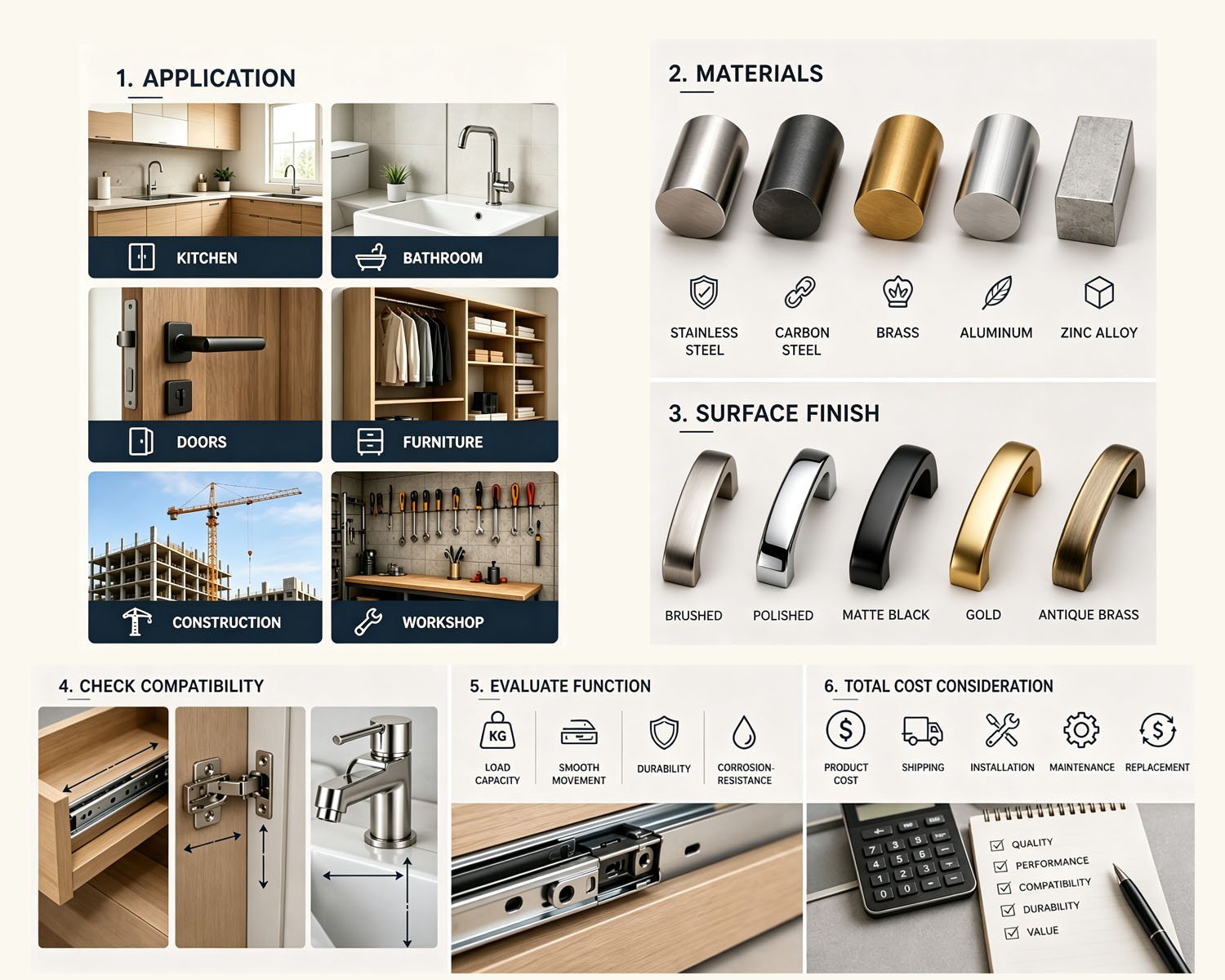
The first step in choosing the right hardware is understanding where and how the product will be used.
Hardware products are used in furniture, kitchens, bathrooms, doors, storage systems, construction projects, workshops, and many other applications. Each environment creates different requirements.
For example, a drawer slide used in a bedroom cabinet may experience relatively light daily use. A drawer slide installed in commercial furniture may need to withstand much more frequent opening and closing.
The same principle applies to other hardware.
A bathroom faucet needs good resistance to water and moisture. A floor drain needs effective drainage and suitable sealing. A fastener used in construction needs appropriate strength and dimensional accuracy.
Before requesting a quotation, buyers should identify several basic requirements:
l Application and installation location
l Expected load
l Frequency of use
l Indoor or outdoor environment
l Exposure to moisture or chemicals
l Required service life
l Installation method
Having this information ready helps suppliers recommend products based on actual requirements instead of simply comparing prices.
Because hardware is such a broad product group, identifying the correct category is essential.
For furniture projects, common products include drawer slides, furniture hinges, handles, cabinet fittings, and other furniture accessories.
For doors and entrances, buyers may need door handles, pull handles, locks, door-control hardware, and sliding door hardware.
For construction and maintenance, screws, bolts, nuts, washers, pins, and hand tools are frequently required.
Bathroom projects may require faucets, floor drains, and other bathroom hardware.
Storage and commercial projects can also involve shelving and storage racks.
Understanding these categories makes purchasing more organized. It also allows buyers to create a complete product list before contacting suppliers.
For larger projects, it can be useful to group products by application rather than simply listing individual items.
For example:
Furniture: drawer slides, hinges, handles, fittings
Doors: handles, locks, door-control hardware
Bathroom: faucets, floor drains
Construction: screws, bolts, nuts, washers
Installation: hand tools
This approach reduces the possibility of missing important accessories during procurement.
Material is one of the most important factors affecting hardware performance.
Common materials used in hardware manufacturing include stainless steel, carbon steel, brass, aluminum, zinc alloy, and other metal materials.
Stainless steel hardware is often selected when corrosion resistance and durability are important. It can be particularly useful for bathroom, kitchen, architectural, and other moisture-exposed applications.
Brass hardware is commonly used for faucets, handles, decorative fittings, and other applications where appearance and corrosion resistance are important.
Aluminum hardware offers the advantage of relatively low weight and can be suitable for furniture, architectural, and decorative applications.
Zinc alloy hardware provides good casting flexibility, making it suitable for handles, furniture fittings, and products with more complex shapes.
Carbon steel hardware is widely used for screws, bolts, brackets, and other applications where strength is a major consideration.
However, buyers should not assume that one material is always better than another.
The right material depends on the application, performance requirements, budget, and surrounding environment.
Even a high-quality hardware product may fail if it does not fit the application.
Dimensions should therefore be confirmed before purchasing.
For drawer slides, buyers should check drawer length, cabinet dimensions, installation clearance, mounting position, and load capacity.
For furniture hinges, important dimensions can include the hinge cup size, mounting distance, opening angle, door thickness, and overlay.
For screws and bolts, buyers need to confirm diameter, length, thread type, head style, and strength requirements.
For faucets, installation hole dimensions and connection sizes should be checked.
For floor drains, the drain size, installation depth, drainage structure, and connection requirements should be confirmed.
Whenever possible, buyers should provide drawings, product specifications, or samples to the supplier.
This is particularly important for customized hardware.
Hardware is not always hidden.
Handles, faucets, hinges, locks, and other visible products can have a major influence on the overall appearance of furniture, doors, kitchens, and bathrooms.
Common finishes include brushed, polished, chrome, matte black, gold, antique brass, and other customized finishes.
The finish should match the surrounding design.
For example, a modern kitchen may use simple brushed or matte finishes, while traditional furniture may use antique or decorative finishes.
Surface treatment also has a functional role.
Depending on the application, a suitable finish can improve resistance to corrosion, scratches, wear, and daily cleaning.
For bulk projects, buyers should approve a physical sample before mass production to confirm color and finish consistency.
Quality should not be judged only by how a product looks.
Different hardware products require different quality checks.
For drawer slides, buyers should focus on smooth movement, load capacity, extension, stability, and repeated-use performance.
For furniture hinges, opening and closing performance, structural strength, alignment, and adjustment are important.
For fasteners, thread accuracy, dimensions, material, surface treatment, and strength requirements should be considered.
For faucets, buyers may evaluate the body material, cartridge, sealing performance, water flow, connections, and surface finish.
For hand tools, grip comfort, material, durability, and working precision are important.
The most effective quality inspection process is therefore product-specific.
Price is an important part of purchasing, but the lowest quotation does not always represent the lowest overall cost.
A low-cost hardware product that requires frequent replacement may become more expensive over time.
Similarly, inconsistent dimensions can increase installation labor costs.
Delayed delivery can also affect a construction or furniture production schedule.
Buyers should therefore consider total cost, including:
Product Cost + Shipping + Installation + Maintenance + Replacement
A slightly higher-quality product may provide better value if it reduces failures and replacement requirements.
Choosing the right hardware products requires more than comparing prices.
Buyers should consider the application, product category, material, dimensions, compatibility, surface finish, functional performance, and supplier capability.
From drawer slides and furniture hinges to fasteners, door handles, locks, faucets, floor drains, storage hardware, and hand tools, every product should be selected according to its intended use.
For bulk purchasing, sample approval and clear technical specifications can significantly reduce procurement risks.
The best hardware solution is not necessarily the most expensive or the cheapest. It is the product that provides the right combination of performance, durability, compatibility, appearance, and value for the project.
Originally worried about color differences, but the actual product has a more textured feel than the pictures!!!
Fast shipping, careful packaging. The product quality is great, highly recommended.^_^
Seven Continents Global's materials engineers provided three modification solutions and produced test samples within two weeks.
1 NORTH BRIDGE ROAD, #18-06, HIGH STREET CENTRE, SINGAPORE 179094
