
 English
 한국어
 简体中文
 Русский
 Português
 Français
 Deutsch
 Español
 Árabe
 日本語
 हिंदी
 Prancis
 Türkçe
 Tiếng Việt
 Italiano
 ไทย


September 11, 2026
Bathroom vanities are one of the most important products in a modern bathroom, but sourcing the right one can be challenging. Buyers need to consider more than appearance. A vanity that looks attractive in a catalog may not be suitable for humid environments, different installation standards, or the preferences of the target market.
For importers, wholesalers, retailers, and project buyers, choosing the wrong bathroom vanity can result in moisture damage, transportation problems, installation complaints, and high after-sales costs.
This guide explains how to choose a high-quality bathroom vanity by evaluating materials, construction, countertop options, storage design, size, and packaging. Understanding these factors can help buyers select products that are both attractive and commercially practical.
The cabinet material directly affects durability and moisture resistance.
Solid wood bathroom vanities are popular in premium markets because they provide a natural appearance and strong structure. However, wood must be properly treated to reduce the risk of moisture damage.
Plywood is another widely used material. High-quality plywood can offer good strength and moisture resistance, making it suitable for bathroom environments.
MDF is often used for painted bathroom cabinets because it provides a smooth surface. However, standard MDF may be less suitable for areas with high humidity unless appropriate moisture-resistant treatment is used.
PVC bathroom vanities are highly resistant to water and are often selected for humid environments or budget-oriented markets.
When comparing bathroom vanities, buyers should ask suppliers not only what material is used but also how the material is treated and protected.
Bathrooms are naturally humid environments.
A vanity must be designed to withstand water vapor, temperature changes, and occasional contact with water.
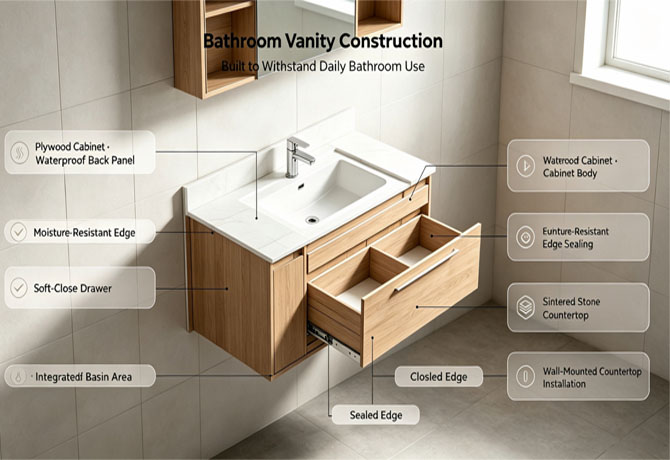
Pay attention to cabinet edges, back panels, drawer construction, and areas near the basin.
Poor edge sealing can allow moisture to enter the cabinet material. Over time, this may cause swelling, deformation, or surface damage.
High-quality bathroom vanities should have carefully finished edges and stable construction.
For buyers sourcing large quantities, requesting product samples or factory quality information before placing an order can help identify potential problems early.
The countertop and basin are important for both appearance and functionality.
Ceramic basins remain a popular choice because they are easy to clean and widely accepted by consumers.
Artificial stone and sintered stone countertops can provide a more premium appearance and greater design flexibility.
Integrated basins are also increasingly popular because they create a clean and seamless look.
When selecting a basin, buyers should consider size, faucet hole position, overflow design, drainage compatibility, and ease of cleaning.
The vanity countertop should also match the overall market positioning.
For example, a simple ceramic basin may be suitable for large residential projects, while a stone countertop may be more appropriate for premium apartments or hotels.
Bathroom sizes vary significantly between countries and property types.
A large double-sink vanity may work well in luxury homes but may not be suitable for compact apartments.
Common vanity widths include 600 mm, 800 mm, 900 mm, 1000 mm, and 1200 mm, although buyers may require customized sizes for specific markets.
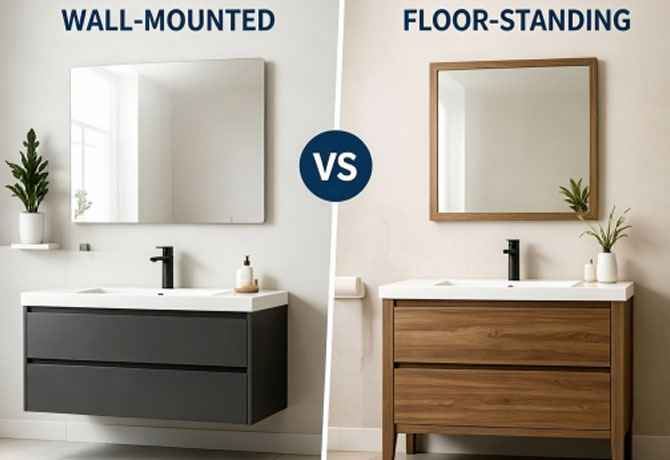
Wall-mounted vanities are popular because they create a more modern and spacious appearance. They can also make floor cleaning easier.
Floor-standing vanities may offer easier installation and additional structural support.
Before placing an order, confirm the preferred size range and installation style in your target market.
Modern consumers expect bathroom furniture to provide both style and practical storage.
Drawers, cabinets, open shelves, and internal organizers can all improve the functionality of a bathroom vanity.
Soft-close drawer systems are particularly popular in mid-range and premium products because they provide a smoother user experience.
However, buyers should not add unnecessary complexity simply to increase the number of features.
The best storage design depends on the target customer.
Compact apartments may require efficient storage in a small cabinet, while luxury residential projects may focus more on large drawers and premium internal organization.
Bathroom vanity trends change over time, but some styles remain consistently popular.
Minimalist designs, floating cabinets, natural wood finishes, matte colors, and integrated basins are commonly used in modern bathroom projects.
However, product selection should always consider the preferences of the local market.
A design that sells well in Europe may not be the most suitable option for North America, the Middle East, or Southeast Asia.
Wholesalers should consider offering a combination of classic and modern designs rather than relying on only one style.
This creates a more flexible product portfolio for different customer groups.
Bathroom vanities are relatively large products and can be easily damaged during international transportation.
Packaging quality should therefore be part of the purchasing decision.
The cabinet, basin, countertop, mirror, and accessories may all require different levels of protection.
Ask suppliers how the products are packed and whether reinforced corners, foam protection, or customized export cartons are available.
For importers purchasing containers, loading efficiency is also important.
Flat-pack designs or optimized packaging may help reduce transportation costs and improve container utilization.
Choosing the right bathroom vanity requires a balance between design, durability, functionality, and price.
Buyers should carefully evaluate cabinet materials, moisture resistance, countertops, basin types, storage design, installation methods, and packaging.
Instead of focusing only on the product photo, ask for detailed specifications and samples whenever possible.
For wholesalers, retailers, and project buyers, a reliable bathroom vanity supplier can also provide support with customized sizes, colors, materials, packaging, and complete bathroom product solutions.
By understanding your target market and selecting products based on real customer needs, you can build a more competitive and profitable bathroom vanity product range.
Originally worried about color differences, but the actual product has a more textured feel than the pictures!!!
Fast shipping, careful packaging. The product quality is great, highly recommended.^_^
Seven Continents Global's materials engineers provided three modification solutions and produced test samples within two weeks.
1 NORTH BRIDGE ROAD, #18-06, HIGH STREET CENTRE, SINGAPORE 179094
